Message Us
 Call Us
 Who May Be Liable for a T-Bone Collision in Texas?
By Anderson, Cummings & Drawhorn, LLP on April 05, 2022
By Anderson, Cummings & Drawhorn, LLP on April 05, 2022
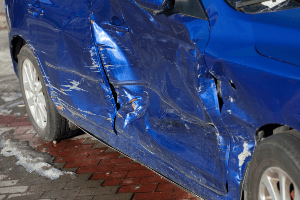
A T-bone collision is one where the side of a vehicle is impacted by the front of another. These collisions are sometimes called side-impact or broadside accidents. Determining liability for these types of crashes may require looking at several factors, including who had the right of way. Depending on how the crash occurred, establishing fault may be simple or complex.
Table of Contents
Let our Fort Worth-area car crash lawyers review your claim to determine how we may be able to help you secure compensation for your damages. There are no upfront fees while we work on your case and the initial consultation is free.
Generally, a T-bone collision occurs because one driver violates the right of way of another. These are some of the more common scenarios when T-bone collisions are more likely to occur:
Aside from violating the rules of the road or driving recklessly, a driver could cause a T-bone accident if he or she is under the influence of drugs or alcohol or is distracted while driving.
As violating another driver’s right of way is usually a strong implication of fault, victims’ attorneys often need to establish that another driver violated their right of way.
For example, the driver who negligently crosses an intersection and causes a T-bone collision could be found to be responsible for the crash if the other vehicle had the right-of-way. On the other hand, if the vehicle making the turn in the intersection had a green light or some other indicator establishing that he or she had the right of way, the driver of the oncoming vehicle could be the responsible party.
Ultimately, fault is based on which driver acted negligently, and there are many T-bone accidents where both parties could be partially at fault.
Every case is different, and reviewing the facts is important to help determine who may be liable. It would be in your best interest to speak to an attorney right away if you were injured in a T-bone collision.
If you believe your right of way was violated in a T-bone collision, you can file a claim for compensation with that driver’s liability insurance. However, to recover compensation you must prove that other driver’s negligent actions directly resulted in your injuries.
Our attorneys are prepared to help you gather the evidence you need to build a strong case. Some of the evidence that may help prove fault in a T-bone collision includes:
When proving which driver had the right of way is more difficult, an attorney may turn to an expert witness who could reconstruct the accident to try to determine which driver acted negligently.
T-bone car accident injuries can be very serious, as the side of a vehicle is not usually reinforced the way the front and the back is.
If you are T-boned at an intersection by a driver who ran a red light or stop sign, your body is likely to jerk in a sideways motion in reaction to the impact. This could cause a serious head, neck or back injury. In addition to that jerking of your body, your head could slam into something solid inside your vehicle, like the door frame, resulting in a concussion or something more serious.
Other common injuries include:
Victims of these injuries will likely need extensive medical treatment that could be costly.
If you were injured in a T-bone collision, let our knowledgeable attorneys help you file a claim and build a strong case for compensation on your behalf.
We offer a free consultation and we do not charge you anything up front. There are no fees unless we win. There is no risk to you.
No upfront fees. No risks. Call (817) 920-9000 today.

This page has been written, edited, and reviewed by a team of legal writers following our comprehensive guidelines. This page was approved by attorney Seth Anderson, whose team has more than 50 years of combined legal experience in helping victims of personal injury seek justice.

Slip-and-Fall accidents in Fort Worth businesses are not only common but also often surprisingly serious. Fort Worth is growing rapidly in terms of both population and economic growth, and some businesses cut safety corners in their rush to keep up. If you’ve been injured in a slip-and-fall accident as a...
Read Article
There are a few industries that are more dangerous than oilfields, but some oilfield jobs are more dangerous than others. The Bartlett Shale is directly underneath Fort Worth and the surrounding area, and this translates to oilfield jobs. If you’ve been injured on the job while working in an oilfield,...
Read Article
No one needs to explain to you just how dangerous oil rig explosions are. These life-threatening accidents are not only exceptionally dangerous but are also challenging legal matters. If you or someone you care about was injured in an oil rig explosion, reach out to our experienced Fort Worth oil...
Read ArticleTell us about your accident and your injuries. An injury lawyer from our team will call and provide you with a free evaluation of your case. If we can help, and you are unable to travel, we will come to your home, office, or hospital. It’s easy – let’s get started.

Email us anytime and we will get back to you.

Our attorneys will come to your home, office or hospital at your convenience.

Our team is ready and waiting to help you today.